

Imagine stepping into your favorite clothing store to buy a good pair of jeans you had your eyes on. But instead of finding the clothing assorted and displayed by fit, size, and color, you find them randomly stacked without the product tagging that differentiates them.
Would you stay and sort through the mess to find the jeans you want? Probably not.
That’s exactly what online shoppers do if an online store has improperly tagged products. When product metadata is missing, incomplete, or messy, even your best products become completely invisible to the people looking for them.
In modern ecommerce, catalog management isn’t merely a behind-the-scenes chore; it’s what drives your store’s user experience. The numbers back this up: research shows that site search users convert at rates 1.8x to 3x higher than standard browsers. Yet, up to 20% of internal site searches return zero results. Most of the time, that happens because of poor product tagging and not because the item is out of stock.
Let’s dive into how AI product tagging actually works, why granular attributes are critical for discoverability, and how smart automation can fix your catalog headaches for good.
What is AI Product Tagging for Ecommerce?
AI product tagging is the automated process where algorithms are trained to scan unstructured product information from raw images, vendor feeds, and basic descriptions. It then assigns accurate, detailed tags to every item in your catalog.
Artificial intelligence replaces the manual effort of typing out details like “V-neck,” “100% Cotton,” “Midi Length,” or “Boho Style” SKU by SKU, and extracts those characteristics in seconds.
By pulling out these micro-attributes, product attribute tagging helps categorize products logically, ensuring rich, structured catalogs. This structured data is what powers your site search, filtering sidebar, visual recommendations, and marketplace feeds, making every item effortless to find.
How AI Product Tagging Works Behind the Scenes
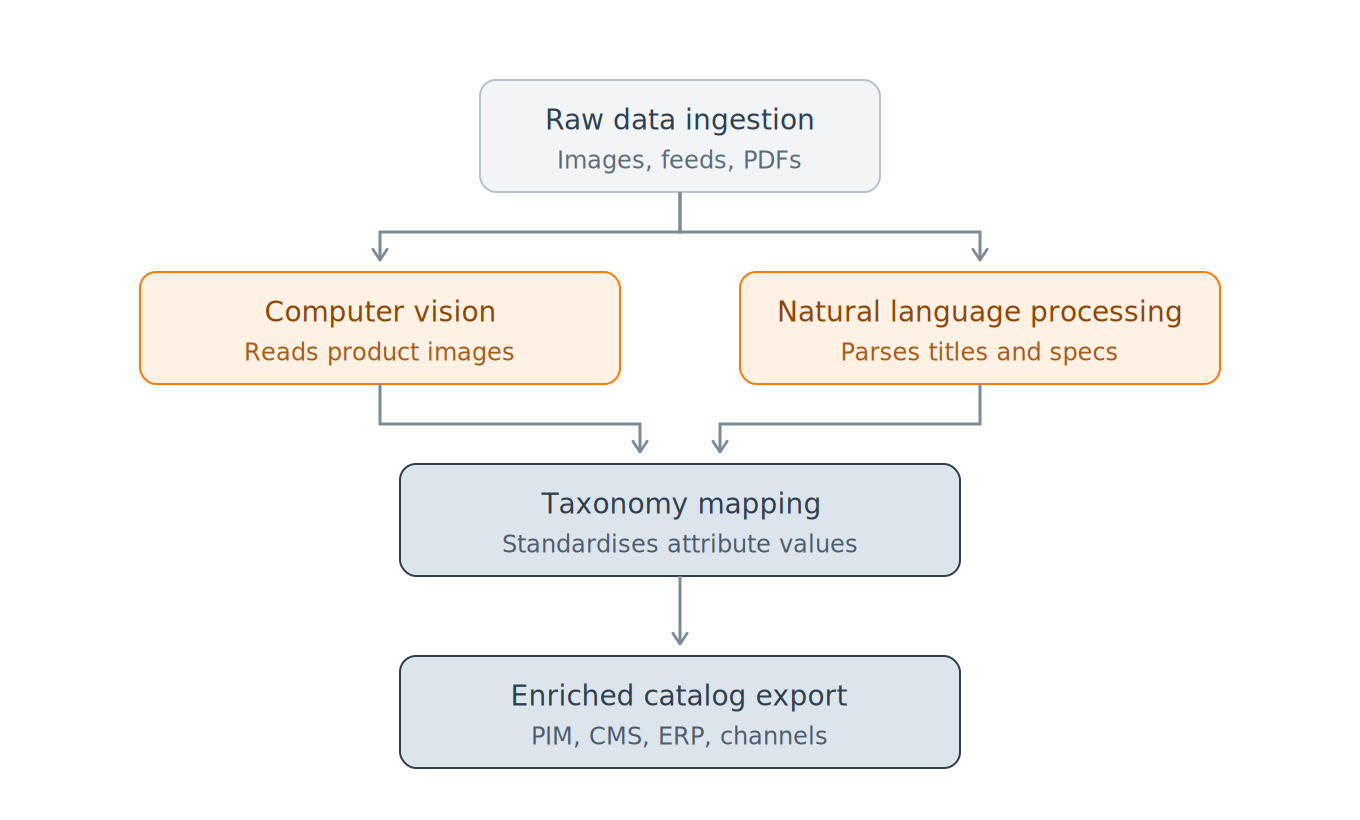
Automated product tagging goes way beyond basic keyword matching. The system evaluates products by merging visual recognition with contextual text analysis, driven by an underlying machine learning framework.
1. Ingesting Raw Data
The engine pulls in raw data from whatever sources you use: supplier spreadsheets, image folders, manufacturer PDFs, or existing product feeds.
2. Computer Vision (Analyzing Images)
Computer vision looks at your product photos pixel by pixel. It detects visual attributes like patterns (houndstooth, striped), cuts (A-line, cropped), shoe styles (ankle boot, platform), or furniture finishes (matte black, brushed brass) for accurate tagging.
3. Natural Language Processing (Parsing Text)
At the same time, NLP scans titles and descriptions to pull out key specifications like material compositions (GORE-TEX, Organic Linen), dimensions, or sizing details. It also standardizes tricky variations like mapping “crimson,” “ruby,” and “scarlet” under a single “Red” filter facet.
4. Taxonomy Mapping & Standardization
The AI maps these extracted attributes directly to your custom category structure. It catches missing details, resolves conflicting tags, and keeps your entire catalog consistent.
5. Seamless Data Export
Finally, those enriched tags are pushed right into your PIM, CMS, ERP, or channel managers through REST APIs, JSON files, or CSVs.
Why Enriched Attributes Drive Real Revenue
Why are top retail brands ditching manual data entry for AI enrichment? Because better product attribute tagging directly improves customer experience and sales performance across four big areas:
1. Killing Off the “Zero-Results” Page
If a buyer types “waterproof running jacket with hood” into your search bar, a simple keyword tool might fail if the product title is just “Men’s Rainshell Coat.” AI tagging solves this by automatically attaching hidden tags like #waterproof, #hooded, and #running. The shopper finds what they want immediately instead of checking out a competitor.
2. Powering Frictionless Filter Sidebar Search
Shoppers don’t want to scroll through 40 pages of inventory—they hit the filter bar. If someone checks “Mid-Century Modern” or “Sleeveless,” any product lacking those specific tags instantly disappears from their screen. Good tagging keeps relevant products in front of buyers.
3. Boosting On-Page SEO & AI Engine Optimization (AEO)
Modern search engines—and AI discovery tools like ChatGPT or Google AI Overviews—depend heavily on structured catalog schema to answer conversational queries. Deeply tagged catalogs give search algorithms the exact semantic context they need to rank your products for long-tail searches like “sustainable linen summer dresses under $100.”
4. Supercharging Product Recommendations
Recommendation widgets only work as well as the data feeding them. When your system understands that a shopper is looking at a matte black, ergonomic desk lamp, it can instantly recommend matching office accessories with identical design tags, lifting your Average Order Value (AOV).
Industry-Specific Use Cases
Smart product tagging adjusts to the specific needs of different product categories:
- Fashion & Apparel: Standardizes sizing across brands, identifies necklines and fits, extracts fabric blends, and processes large seasonal drops fast.
- Electronics & Gadgets: Extracts technical specs—like port types, battery life, screen refresh rates, and hardware compatibility—directly from dense manufacturer specs.
- Home & Furniture: Tags items by design aesthetic (boho, industrial, minimalist), primary materials, exact dimensions, and room types.
- Beauty & Personal Care: Categorizes products by active ingredients (hyaluronic acid, niacinamide), finish types (dewy, matte), and targeted skin concerns.
Scaling Ecommerce Effortlessly with eComNeo
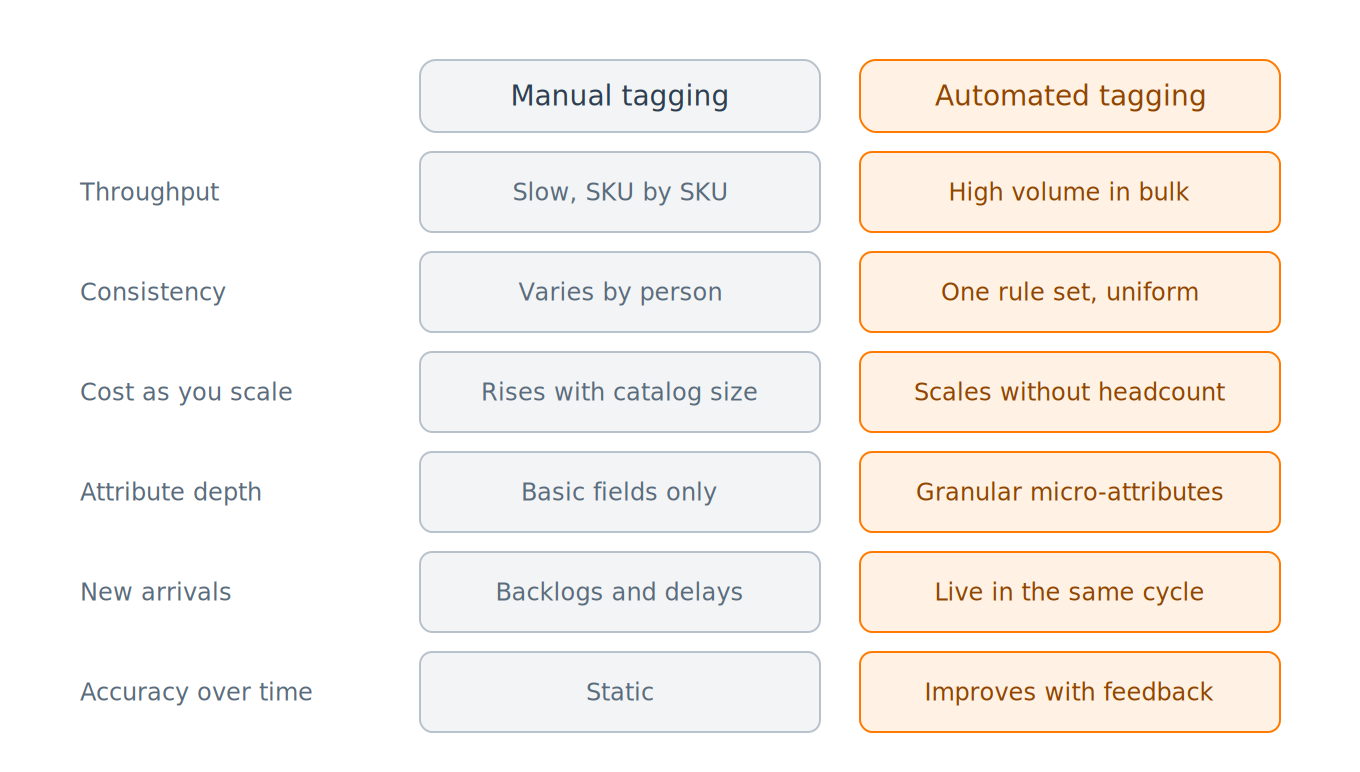
When your product line expands, tagging items manually quickly becomes a massive bottleneck. Human tagging is notoriously slow, expensive, and inconsistent, creating backlogs that keep new arrivals hidden in the back room for weeks.
That’s where eComNeo comes in.
eComNeo is an AI-powered, automated product tagging platform designed to automate catalog enrichment from end to end. Combining computer vision, advanced NLP, and adaptive machine learning models, it helps ecommerce teams tag high-volume catalogs quickly and accurately.
What Makes eComNeo Stand Out:
- Multi-Format Ingestion: Easily processes product images, raw vendor feeds, and marketplace data simultaneously.
- Flexible Integrations: Connects directly into your current PIM, CMS, or ERP setup via flexible REST APIs, JSON, or CSV data exports.
- Self-Improving Engine: Features built-in feedback loops, meaning the system gets smarter and more accurate with every catalog update.
- Enterprise Governance & Security: Built with full audit trails and robust data governance so you always know how your product data is being processed.
Ecommerce Product Tagging Best Practices
Thinking about automating your catalog workflows? Here are the product tagging best practices to follow:
- Clean Up Your Core Taxonomy First
Define your main categories and attribute rules clearly before letting automated tools take over.
- Combine Visual and Text AI
Don’t rely on image recognition alone or text parsing alone—using both together gives you the cleanest data.
- Keep an Eye on Search Logs
Regularly check your site’s zero-result search reports to spot emerging buyer trends or missing tag variants.
- Pick a Flexible Solution
Work with adaptable tools like eComNeo that can evolve as your product lines and customer search habits change.
Stop Letting Bad Data Hide Your Products
If buyers can’t find your products easily, they can’t buy them. In today’s competitive landscape, fast, accurate, and detailed product tagging is one of the easiest ways to improve site search and grow sales.
By ditching manual data entry for an intelligent platform like eComNeo, you can eliminate zero-result searches, get new inventory live faster, and deliver the smooth shopping experience your customers expect.
Ready to transform your ecommerce product catalog into a search engine magnet? Schedule a demo with eComNeo today to see smart automated tagging in action.
Leave a Reply