
Most fashion ecommerce teams aren’t short on ideas for content. They’re short on the capacity to produce it at the volume their catalog actually needs. A mid-size apparel brand might be carrying hundreds, sometimes thousands, of SKUs in a season, and nearly all of them need on-model imagery to convert.
Traditional product photoshoots haven’t gotten any faster or cheaper to solve that, and AI product photography that skips the compositing step entirely doesn’t really solve it either. Studio rates keep climbing. Casting a model still eats real time. Post-production backlogs quietly push go-live dates back, week after week, and when one product misses its launch window, it doesn’t stay contained; it drags the entire campaign calendar behind it.
AI on-model imagery is changing that math. One global fashion brand cut on-model photography costs by 50% using exactly this approach. Not by replacing the need for good imagery, but by changing how it gets made, how long it takes, and what it costs.
This is what eComNeo’s on-model imagery platform is built for, and this piece breaks down how it works, what it costs, and what to look for when deciding if it’s right for your catalog.
Why Traditional On-Model Photography Doesn’t Scale
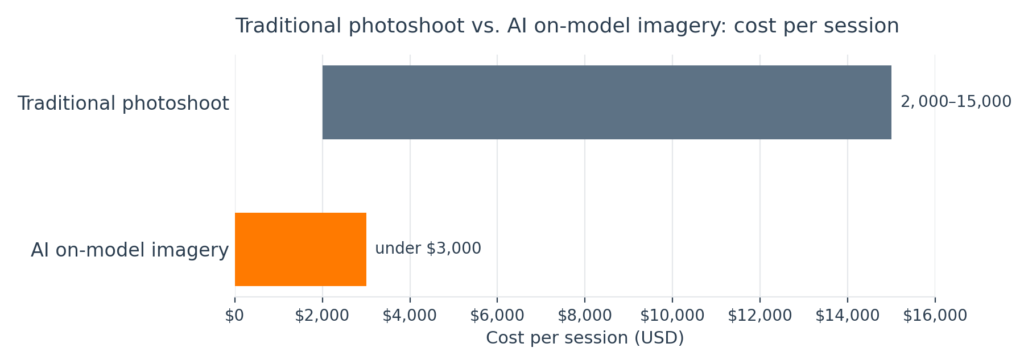
A single product photoshoot session, studio rental, model fees, a stylist, a photographer, and post-production retouching typically land somewhere between $2,000 and $15,000. That’s before travel, logistics, or the reshoot nobody wanted because a garment didn’t drape right on camera.
The deeper problem isn’t the cost, though. It’s structural. Most brands only manage to photograph a portion of their catalog on-model each season, with the rest going live as flat lays or mannequin shots, formats that consistently underperform on-model imagery when it comes to conversion.
Try to close that gap, and the costs compound. More SKUs mean more shoot days. More shoot days mean more logistics. And every time a new collection drops mid-season, or a product gets revised, the whole pipeline resets from scratch.
Searching for an “AI Fashion Model Generator”? Here’s What You Should Know
If a search for an AI fashion model generator or AI product photography tools brought you here, it’s worth understanding what that category actually covers before you evaluate anything. Fully generative fashion model tools synthesize model images from scratch using diffusion models. The outputs are improving, but an experienced ecommerce director will still spot the tells, hands that don’t quite work, fabric that drapes wrong, lighting that reads as synthetic.
AI on-model imagery is a different approach, and it’s the one that actually solves the production problem most fashion teams have. Instead of generating models or garments, it starts with a curated repository of real, consented models photographed in a controlled studio environment. AI model compositing fashion technology then places the actual garment onto the selected model, matches lighting and shadow, and generates a realistic background. Nothing about the output is synthetic. It reflects exactly how the real garment looks, because it is the real garment, fitted computationally onto a real person.
That distinction comes down to one thing: garment accuracy. A generative tool is guessing what a garment might look like. Compositing technology renders what the product actually looks like. For catalog-scale ecommerce, where a shopper’s decision to buy depends on accurate drape, texture, and fit, that difference is the whole ballgame.
It’s also why major marketplaces treat on-model imagery as a requirement, not a preference, Amazon mandates on-model photography for adult apparel listings.
eComNeo’s platform works exactly this way: real garments composited onto a curated library of consented human models, with AI handling the fitting, lighting match, and background generation.
The Cost of Traditional On-Model Photography
Delayed product launches carry a cost most teams underprice. A photoshoot cycle, from brief to production-ready images, typically runs two to four weeks. Fine if the calendar has slack. It rarely does. Brands working tight seasonal windows or chasing a trend feel that lag directly: products go live late, paid campaigns sit waiting, marketplace listings stay incomplete longer than anyone wants.
Model diversity gets squeezed too. Most brands, limited by shoot logistics and budget, photograph each garment on a single model. Recasting for other body types, skin tones, or regional markets means booking an entirely separate shoot, and in practice, most teams quietly skip it rather than absorb the cost.
Then there are reshoots. Garments change. Colorways get added. Sizing ranges expand. A product shot in March may need new imagery by June, and every revision triggers a fresh shoot request, a fresh cost, and a fresh delay.
The on-model photography and product photoshoot cost per SKU is where all of this shows up on a spreadsheet. Divide a $10,000 shoot session by the number of garments a crew realistically captures in a day, and per-SKU cost lands around $80 to $200, before retouching. Scale that against a catalog adding 500 to 1,000 new SKUs a season, and that number stops being a line item. It becomes a ceiling on how much of the catalog ever gets proper on-model coverage at all.
AI On-Model Imagery: The Cost Breakdown
The cost reduction isn’t magic. It’s the removal of specific line items.
Studio rental, model casting fees, stylist fees, on-set photographer costs, and most post-production retouching disappear entirely. What’s left is AI processing, background generation, and, critically, a human quality review layer that catches errors before any image ships.
A session that used to cost $10,000 to $15,000 can be replicated for under $3,000, delivered in 48 hours instead of two to four weeks. For a brand shooting 200 SKUs a season, that difference compounds fast. This is the real fashion photography cost per SKU that caps how much of a growing catalog ever gets proper on-model coverage under the traditional model, and it’s the exact number AI on-model imagery is built to collapse.
Beyond raw cost, the scalability shift in ecommerce photography matters more. Traditional photography has its limitations; you can only shoot as fast as a studio can run. AI on-model imagery scales with catalog volume instead. A brand going from 200 to 2,000 SKUs doesn’t need ten times the shoot budget. It needs a workflow built for volume.
Diversity at scale becomes feasible, too. Rather than recasting for different markets or body types, brands can select from a model repository and apply the same garment across multiple representations in a single brief. What used to require separate shoot days becomes a configuration choice.
How the AI On-Model Imagery Workflow Works
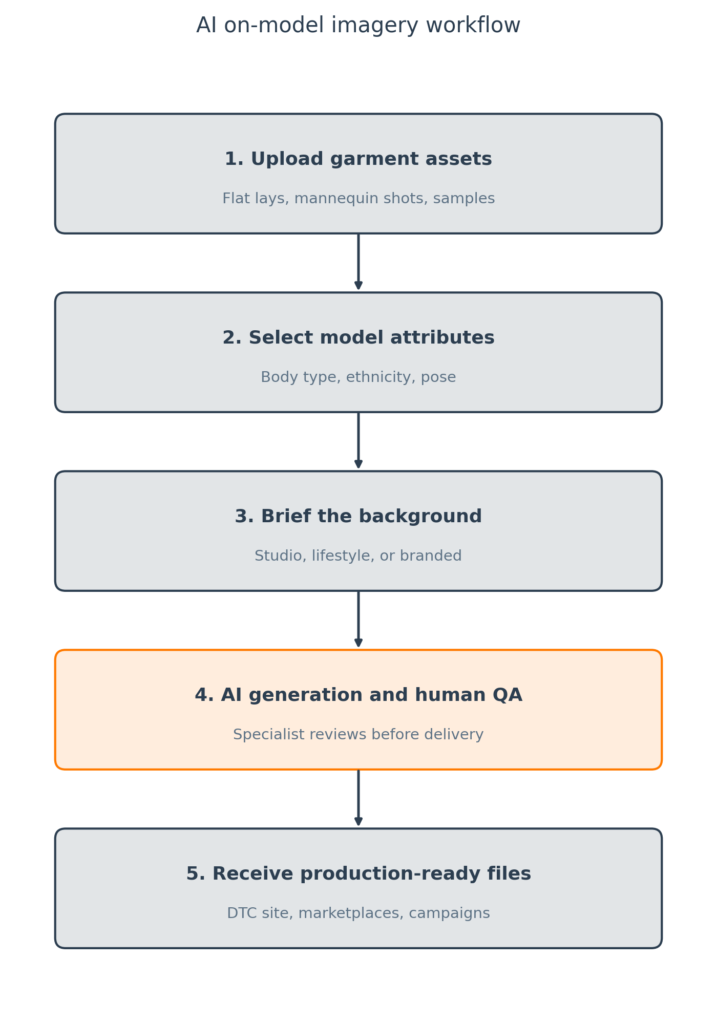
The process itself is deliberately simple:
- Upload garment assets. Flat lays, mannequin shots, or sample images serve as the source for garment fitting.
- Select model attributes. Body type, ethnicity, pose, and any market-specific requirements from a curated repository of real models.
- Brief the background. Studio white, lifestyle setting, or branded backdrop.
- AI generation and human QA. The platform generates composited on-model images, then a specialist reviews them before delivery, specifically to catch garment distortion, lighting inconsistencies, or fabric rendering issues.
- Receive production-ready product imaging files. Formatted for your DTC site, marketplace listings, or campaign assets.
The human review layer isn’t optional overhead. It’s the quality control mechanism that separates production-viable output from raw AI generation.
eComNeo’s approach works exactly this way: real garments composited onto a curated library of consented human models, with AI handling the fitting, lighting match, shadow, and background generation. The output reflects how the real garment looks, because it is the real garment. See how it works.
How to Evaluate AI On-model Imagery Platforms
Not all tools are built the same. Ask these questions before you decide:
- Does the output use real models or fully synthetic ones? Real-model repositories produce more reliable garment draping and more commercially credible results. This is the core differentiator between AI fashion photography tools and true compositing platforms.
- Is human QA built in, or is it on you? AI generation without a mandatory review step introduces consistency risk at scale. Look for platforms where quality control is part of delivery, not something you’re expected to handle after the fact.
- How accurate is garment rendering? Fabric texture, drape, and fit accuracy vary a lot between platforms. Request samples in your specific garment categories before deciding.
- What are the commercial usage rights? Imagery used in paid campaigns needs clear licensing terms.
- Can it handle bulk processing? A platform that works fine for 10 SKUs but breaks at 500 isn’t a real solution.
- Does it integrate with your existing stack? Even upload-based workflows need to fit your content operations without creating new bottlenecks.
- Are the models consented? Some platforms use scraped or synthetic model images with unclear legal standing. Confirm that any platform you use has documented consent from the human models in its repository; this matters both ethically and for brand liability if it’s ever challenged.
Common Mistakes While Adopting AI On-Model Imagery
Using outputs without quality review is the most common one. Raw AI outputs, even good ones, need human validation before going live. Garment distortion and fabric rendering errors are often subtle enough to slip past a casual glance but noticeable enough to affect how the brand is perceived.
Treating on-model imagery as a full replacement for product photography is another. AI on-model imagery is most cost-effective for catalog scale, colorway variations, and diversity representation. Hero campaign imagery meant to carry brand-level storytelling may still be worth a traditional shoot.
Choosing tools based on demo product shots instead of category samples trips people up, too. A platform’s showcase images are curated. Always test with your own garment types; knitwear, tailoring, and sheer fabrics all behave differently under AI compositing than a basic jersey tee does.
And ignoring brand consistency guidelines undercuts everything else. If lighting, pose, or background tone drifts from image to image, the catalog stops looking shot and starts looking assembled, and shoppers tend to notice that faster than any single flawed image.
The Future of Fashion Content Production
On-model imagery at scale is the real shift underway here, not a cost-cutting shortcut, but a structural change in how fashion content gets made. The brands investing in scalable imagery workflows now are the ones who’ll be able to launch faster, cover more of their catalog, and represent their products more inclusively without spending on scaling right alongside them.
The real advantage isn’t just the cost reduction. It’s the operational flexibility. A brand that can produce on-model imagery in 48 hours can respond to trends, test products before committing to a full shoot, and localize imagery for different markets without rebuilding its content pipeline from scratch.
The economics of fashion content are shifting. The real question isn’t whether AI on-model imagery becomes standard practice; it’s whether your content operations are ready to use it before your competitors are.
eComNeo’s product imaging and on-model imagery platform is built for exactly this: scalable, studio-quality output across your full catalog, with model diversity, outfit mixing, and human QA built into the workflow. Contact us for a demo and see how it works with your garment types.
Leave a Reply