

There’s a point in most ecommerce journeys where things stop scaling as smoothly as they used to.
At first, everything feels under control. You’re using a PIM software, your product data is structured, and your catalog looks clean. On paper, your stack is doing what it’s supposed to do.
Slowly, you start to notice the drag. Launches slip by a few days. Some updates don’t make it to every channel. And teams find a temporary fix just to keep operations running.
Nothing is fundamentally broken. But nothing feels fast either.
That’s usually when teams start questioning whether the issue is execution or the way their systems are set up.
PIM software vs unified ecommerce platform: what’s the difference?
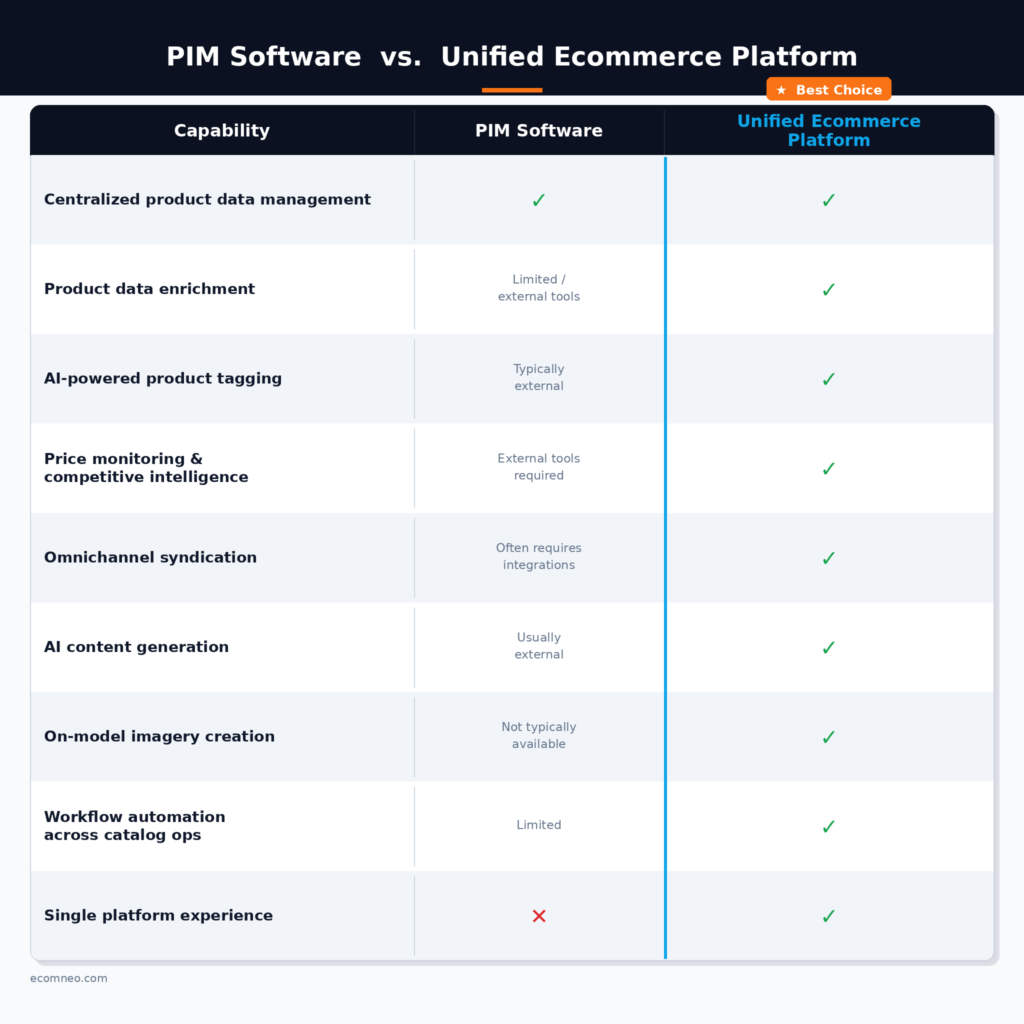
A PIM software is built to centralize and streamline product information, helping businesses maintain consistent and structured product data. A unified ecommerce platform combines product information management with capabilities such as enrichment, tagging, pricing intelligence, content creation, and syndication. While a PIM focuses on organizing product data, a unified platform supports the broader workflows required to manage and scale ecommerce operations.
What a PIM software was designed to solve
A Product Information Management system was built to bring order to chaos. It gave ecommerce teams a centralized place to store, manage, and standardize product data.
For years, that was enough.
It solved the problem of scattered information and inconsistent attributes. It created a reliable foundation that teams could depend on. And for businesses operating on a limited number of channels, that foundation still holds up reasonably well.
But ecommerce operations have changed in ways that a PIM software was never designed to fully handle.
Where the friction actually begins
The real challenge today isn’t managing product data. It’s what happens after that data is ready.
Even after product information is structured, the real work is just getting started. Product data still needs to be enriched and tailored per every marketplace’s rules. Also, it needs to be optimized so shoppers can find it, and continuously updated as prices change. These aren’t one-time tasks anymore; they’ve become part of daily operations.
This is where most teams face challenges.
Because while a Product Information Management (PIM) system centralizes data, it doesn’t handle the full lifecycle of how that data is used. As a result, teams start relying on additional tools. One for tagging, another for enrichment, another for pricing insights, and yet another for syndication.
On their own, each of these tools does its job well. But together, they create a system where workflows are scattered, dependencies pile up, and execution starts to drag.
The problem isn’t that any of these tools is doing a poor job. In fact, most of them do exactly what they’re supposed to do. The issue is that product information now has to move between multiple systems before it reaches the customer.
A simple update might need to be enriched in one platform, tagged in another, and then pushed to different sales channels through a separate syndication tool. As more systems become involved, even routine changes take longer to complete.
That’s when small delays start adding up. Product launches take longer. Updates don’t always appear everywhere at the same time. Teams spend more time checking whether information is consistent across channels and less time focusing on growth.
Research from Forrester points out that fragmented commerce ecosystems are a key reason behind slower time-to-market and higher operational costs. It’s a finding that resonates because it mirrors what many teams are already dealing with day to day.
The shift toward unified ecommerce platforms
This is where the idea of a unified ecommerce platform starts to make more sense.
Ecommerce teams are juggling separate tools for catalog updates, product data enrichment, product tagging, dynamic pricing, and syndication. A unified platform brings all of these operations into one connected workflow, so product information moves smoothly from one stage to the next.
It is not a minor shift. It substantially improves day-to-day operations.
When everything operates within the same system, product data doesn’t need to be exported, reworked, and pushed across platforms. Updates don’t rely on multiple handoffs. Teams don’t spend time reconciling inconsistencies between tools.
Work simply moves faster because there are fewer points of friction.
A study by McKinsey found that organizations that integrate their data and workflows can improve operational efficiency by up to 30 percent. That kind of improvement is rarely about working harder—it’s about removing the structural bottlenecks that slow teams down.
Why this matters more now
As product catalogs expand across websites, marketplaces, retail partners, and social commerce channels, omnichannel product management has become significantly more complex.
Most brands have an omnichannel presence that comes with its own rules and requirements. At the same time, customers expect consistency wherever they interact with a product.
Salesforce says that 79 percent of customers expect companies to deliver consistent experiences across channels. When product data is not aligned, those inconsistencies become visible very quickly.
On the operational side, teams need to move faster without increasing headcount or cost. Keeping that balance in place gets complicated when teams are switching between multiple systems, each operating differently and demanding constant coordination.
So, is a PIM software still enough?
For businesses with smaller catalogs and limited channels, a PIM can still do the job well. It brings structure, keeps data organized, and gives teams a level of control that’s often sufficient at that stage.
But it is complex for larger or growing businesses. More products, more channels, and more frequent updates create demands that go beyond what a standalone PIM can handle.
That said, it’s not about whether PIM is useful. It’s about whether it can support the speed and scale your operations now require.
Where eComNeo fits in
This is exactly the gap that eComNeo is designed to address.
It brings together the capabilities that ecommerce teams typically spread across multiple tools and integrates them into a single platform. That includes catalog management, data enrichment, tagging, on-model imagery, competitive intelligence, price monitoring, and omnichannel syndication.
Importantly, it also includes PIM functionality within that ecosystem. This means teams don’t need to invest in a separate PIM and then build additional layers around it to make it operational.
The advantage isn’t just cost reduction. It’s about managing ecommerce operations through a connected system where data, workflows, and insights stay aligned from the very beginning. For many businesses, that also creates opportunities for greater ecommerce workflow automation across catalog and channel operations.
The bigger picture
The discussion around a PIM software vs. a unified ecommerce platform is ultimately about how ecommerce teams want to operate.
PIM software has solved a foundational problem and continues to play a role in many organizations. But the challenges teams face today are unique.
They don’t just need systems that store product data. They need something that actually supports how that data gets used across the business—whether that’s updating listings, optimizing content, or responding to changes on the fly.
Final Thought
If your current setup lets your team move quickly, keeps things in sync across channels, and doesn’t feel heavier as you grow, then everything is working as it should.
But if growth is starting to slow things down—longer timelines, more manual effort, and a growing dependence on multiple tools—it may be a sign that the setup itself needs a rethink.
Because in 2026, the advantage isn’t just in managing product data well.
It’s in how quickly and effectively you can put that data to work.
Explore eComNeo or schedule a demo to see how a unified ecommerce platform can simplify operations.
Leave a Reply